I once set up a ten-year periodic token for a Vault server and felt good about it. Vault quietly clamped it to its thirty-two-day default ceiling. A month later the server lost its secrets, and I spent a bad morning working out why. The fix was one line in a config file. The real expiry had been queryable the whole time, but nothing had a reason to ask.
The upgrade didn’t break it
When something breaks right after an upgrade, the upgrade gets blamed. Most of the time it just disturbed something that was already wrong, like a token close to expiry or a secret the new version reads at boot that nobody created. The check for each of these fits on one line, and so does the fix. Nobody runs the check because there’s never an obvious moment to, so the problem waits for the next upgrade.
A doctor that only reports
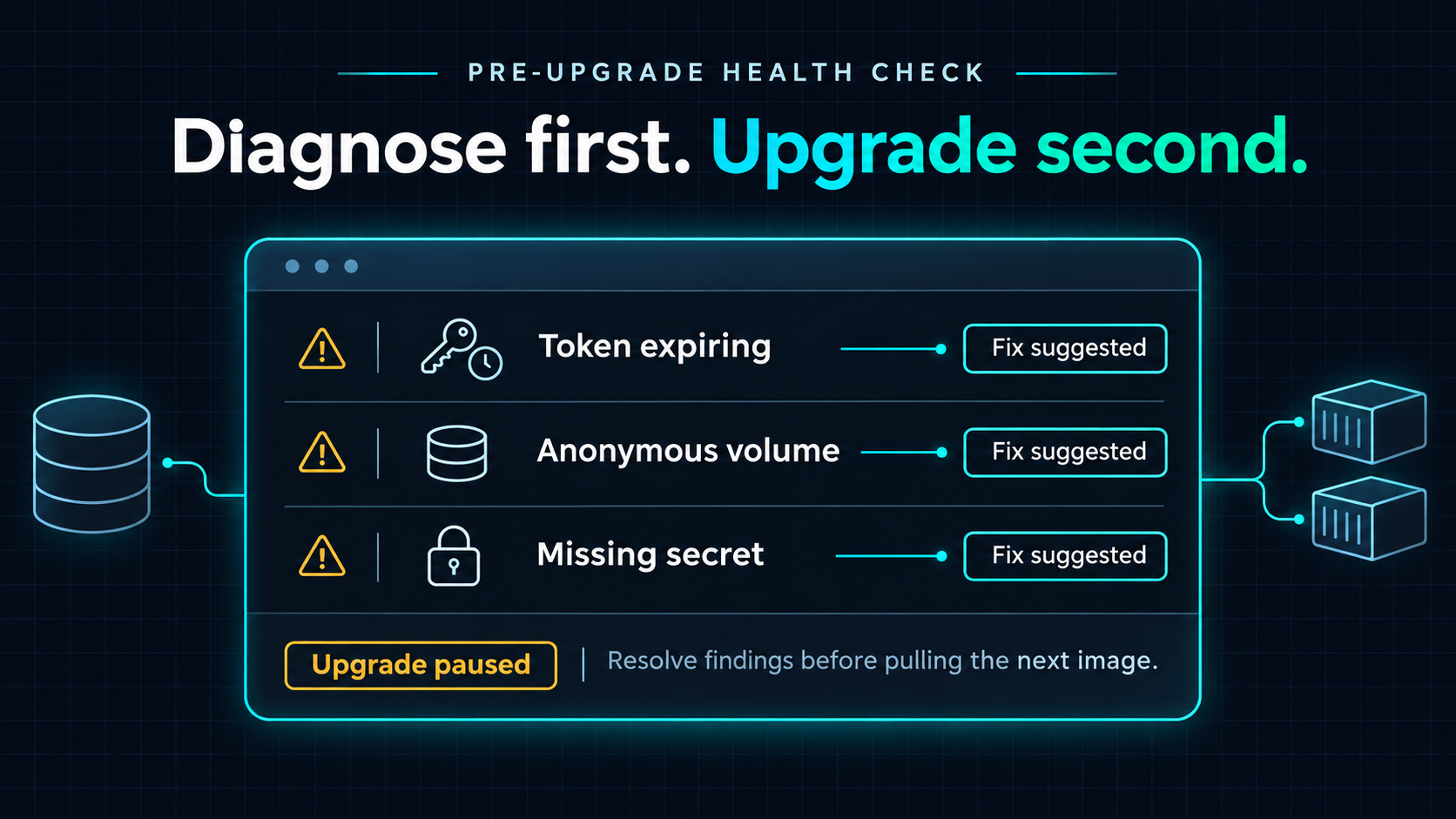
So I built a doctor into Datris, and it never changes anything. A tool that fixes things has to get the timing right and know you wanted the fix, while a tool that reports only has to be right about what it found. Every finding comes with the exact command to run, and you run it when you’re ready.
It checks boring things: token time-to-live, disk past 85 percent, whether the embedding service is serving the model the config names, and databases sitting on anonymous Docker volumes. It also flags env keys that no service in the compose file references, which means the value never reached a container. Every check is there because it cost me or someone I know a day.
When it runs
At boot it logs a cheap subset of checks, and on a clean install it stays quiet, because a health check that nags on a healthy system teaches people to ignore it. When you upgrade with the Datris CLI installed, the installer runs the host checks before it pulls anything and refuses to continue on an error. If you turn on the timer, it posts to the incident webhook when a check flips to error and again when it recovers, without repeating itself every hour.
The doctor also runs whenever a tap or pipeline run fails. The recovery agent used to go straight to AI diagnosis, and it couldn’t tell a tap problem from a platform problem. A tap that hit a rate limit is worth retrying, but a full disk will fail the same way every time, and the agent could still end up proposing a re-run that buried the real cause. Now the platform runs the doctor’s quick check first. If the problem would stop any run from succeeding, the incident goes to a person with the fix attached and the model is never called.
The bar
You don’t need my doctor to hold your platform to this standard. Ask it: before I pull the next image, what do you already know is wrong? If the answer is a shrug, the next upgrade is going to take the blame for something it didn’t do.
Todd Fearn is the founder of Datris.ai, an open-source, agent-native data platform built on the Model Context Protocol, and he runs IData Corporation, a data engineering consultancy for financial services firms. He has spent about thirty years building production data infrastructure inside institutions like Goldman Sachs, Bridgewater Associates, Deutsche Bank, and Freddie Mac.