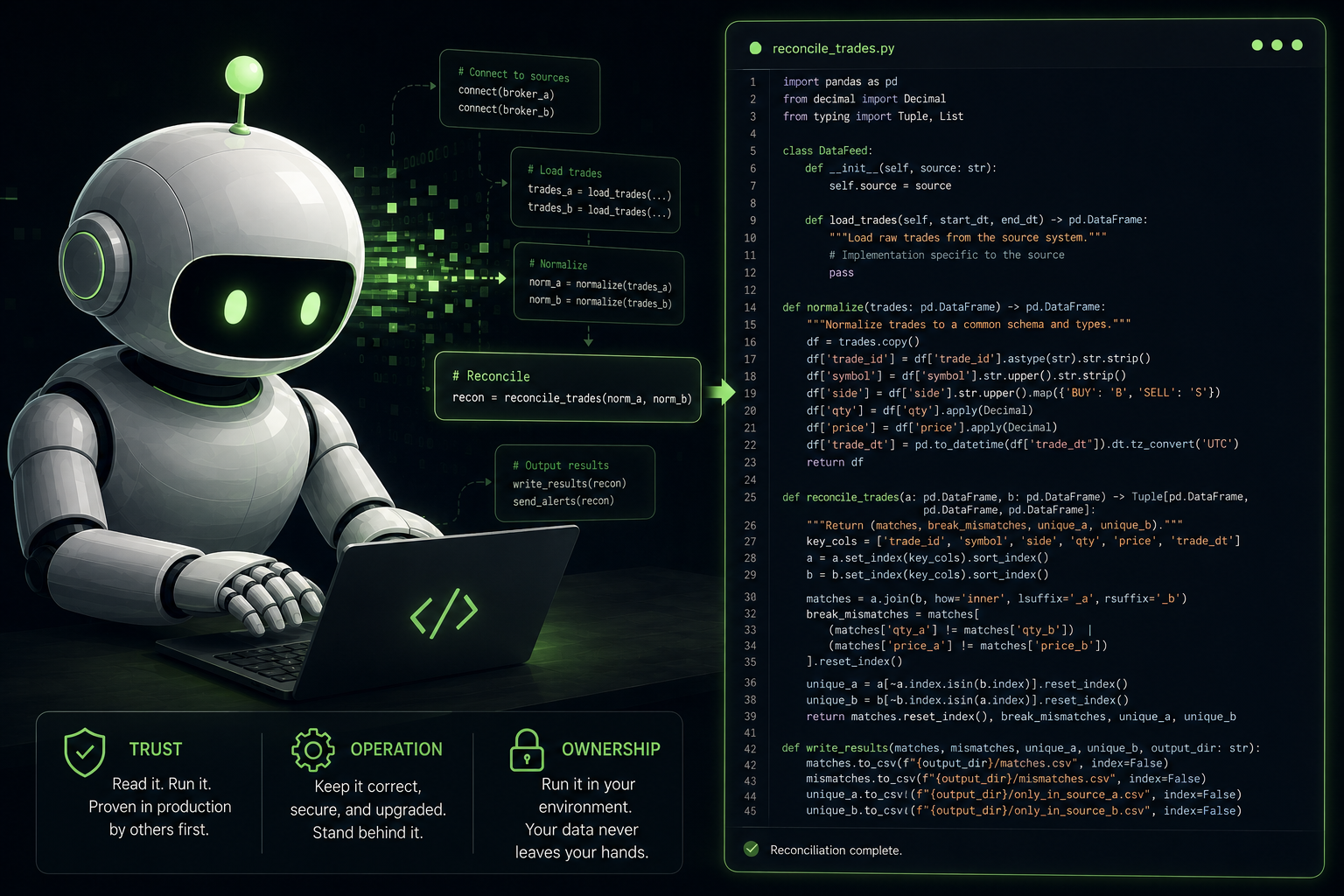
Pick a closed-source vendor you pay for and look at its headline feature, the one on the pricing page that the sales engineer demos. Describe that feature to a capable coding agent and ask it to build you your own version. Just the feature, not the whole product around it.
It won’t be perfect, and it’ll miss the edge cases the vendor learned the hard way. But you’ll have something that works by the end of the weekend, for the price of some tokens. That should make every software business that sells bits a little uneasy: the thing they charge a premium for, the building, is getting cheap fast, and it won’t stop.
The price of building was the business model
For my whole career, software was expensive to build, and that expense quietly was the business model. Writing a real system took scarce people a long time, and that cost was the wall. A competitor couldn’t just copy your product, because copying meant hiring the same expensive people for the same long time, and most wouldn’t. The proprietary codebase was valuable because rebuilding it cost a fortune in salaries. The whole structure rested on building being expensive.
That floor is dropping out. Not all the way to zero, and not evenly, but the direction is clear, and direction is what matters when you’re deciding where value sits in five years. When an agent can reproduce a well-understood feature in an afternoon, the scarcity that made it defensible is gone. A moat made of “this was hard and expensive to build” doesn’t survive in a world where building is cheap.
So what was the moat, really
If it wasn’t the code, what was it? Look at what’s still not cheap.
Trust, first. An agent will build you a data platform over a weekend. The confidence to run it against your regulated production data on Monday is a different thing entirely. That confidence comes from reading every line, and from years of others running it in production and hitting the failure modes first. An agent writes the code. The trust is the expensive part now.
Then operation. Building a system and running one are different jobs, and only one of them got cheap. Keeping it correct, secure, and upgraded, with an audit trail of what ran and what came back, is still real work. And ownership, the thing running in your environment with your data never leaving your hands, is worth more now, not less, because the code around it became commodity.
Every one of those is what open source was already good at, back when it was supposedly the weaker model: you can read it, run it in your own environment, and fork it the day a maintainer disappoints you. It was never selling the bits; those were free the whole time. It sold the right to verify what you run and never be held hostage, and those things don’t go to zero when an agent learns to type.
None of this means free to build is free to run. There’s real money in operating these systems well, in standing behind the thing when it’s three in the morning and a regulated pipeline is down.
Why this is the whole case for Datris
So when people ask why Datris is open source, this is the answer underneath the principle. Many of the teams I build for, in regulated finance, would rather not put their data inside a black box, and for some of it they aren’t allowed to. But the deeper reason is that I don’t want to build a business on the one thing that’s becoming free.
I’ll happily sell a company a commercial license. This isn’t purism. The source is open either way; anyone can read it, run it, fork it. What the license buys is the right to build on it on their own terms, without the AGPL’s copyleft obligations, with support and a warranty behind it. The value there was never access to the code; the code was never the scarce thing. It’s the terms, the support, and someone standing behind it.
The vendors charging a premium for closed bits are selling something whose replacement cost just collapsed. Watch what an agent does to their headline feature over a weekend, and you’ll see it. The code was never the moat. We just spent thirty years where it was expensive enough to look like one.
Todd Fearn is the founder of Datris.ai, an open-source, agent-native data platform built on the Model Context Protocol, and he runs IData Corporation, a data engineering consultancy for financial services firms. He has spent about thirty years building production data infrastructure inside institutions like Goldman Sachs, Bridgewater Associates, Deutsche Bank, and Freddie Mac.