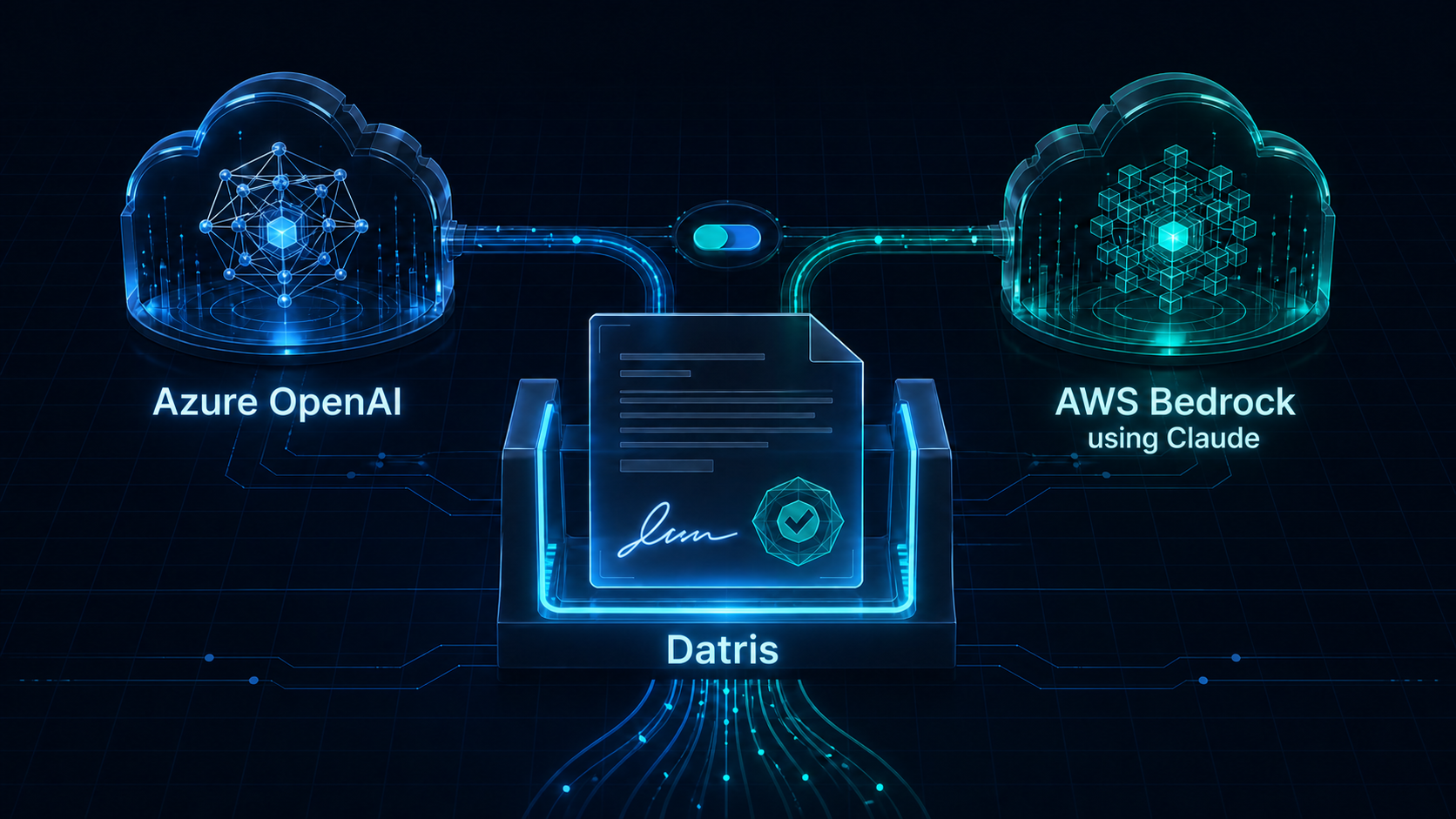
The demo goes great. The agent reads the source, builds the pipeline, validates the data, loads the warehouse. Everyone in the room can see it works. Then somebody from procurement asks the question that actually decides whether any of this ships: does this run on AWS Bedrock or Azure OpenAI?
They’re not asking about latency. They’re asking whether there’s a new vendor in the room. If the answer is no, the agent is calling some provider’s API directly, and now you’re in a different meeting. I’ve sat through enough vendor onboardings at banks to know how that one goes. A new AI provider means a security review, a data processing agreement, and legal reading the terms of service line by line, because the data going into this thing is the regulated thing. Finance has to stand up a billing relationship for an invoice denominated in tokens. Nobody in that chain is being unreasonable. It still takes months. The model was never the bottleneck. The signature was.
But if the answer is yes, most of that meeting never happens. Your company already signed the agreement that matters. Probably years ago.
The agreement you forgot you had
If you run on AWS, somebody negotiated that agreement a long time ago. Security reviewed it, legal read it, finance pays the invoice every month without calling a meeting. Same if you’re an Azure shop. That approval was hard-won once, and today it covers a huge surface area of services that your teams spin up all the time without anyone asking about vendor risk.
Both clouds now serve frontier models inside that same agreement. Claude is available through your AWS account. OpenAI’s models are available through Azure. These are the same models you’d get from the providers directly, running inside the cloud perimeter your company already trusts, under terms your lawyers accepted years ago.
So “can we use AI on this data?” turns into a different question: can we use our cloud on this data? Most teams answered that one a long time ago.
What changes in practice
The inference call stays inside your cloud account. When the agent validates a batch of records or generates a transformation, the data goes to a model endpoint in the same trust boundary where your databases and buckets live. Legal has no new party to evaluate because there is no new party.
Credentials get simpler too. A direct provider relationship is one more API key to issue, store, rotate, and account for. Through your cloud, the models sit behind the IAM policies and access controls your team already manages, and they inherit the audit trail that comes with them.
And the spend lands on the cloud bill, in the cost tooling finance already uses, under a budget process that exists. Nobody has to explain a new line item from a company procurement has never heard of.
The platform’s job is to make this a setting
None of this matters if using your cloud’s models means rebuilding your stack. On a well-built layer, it doesn’t.
The provider is a setting. Point it at Anthropic directly, at OpenAI directly, at Claude through AWS, or at GPT through Azure. Everything downstream keeps working, the pipelines and validation rules and generated transformations and the agents driving all of it, because none of it was ever wired to a particular provider. Pipelines ask for work to be done. The platform decides who does it and how the request gets there.
That’s what makes the procurement story real instead of theoretical. A team blocked on a direct vendor relationship doesn’t wait for the signature. They flip the setting to the cloud they already have, and the agent goes to work this week. If the direct relationship gets approved later, or a better model ships somewhere else, that’s a config change too. The decision stays reversible, which is the only kind worth baking into infrastructure this early.
Whichever cloud you married, you get a frontier model
An AWS shop gets Claude. An Azure shop gets GPT. Neither one is settling. These are the models at the top of the leaderboards, not a compromise option you tolerate because compliance made you.
For years, “approved vendors only” meant doing without, or doing with less. That trade is gone. The approved path and the good path are the same path now, on both clouds. And if your company is multi-cloud, you get something better than a fallback: an actual choice between frontier models, made entirely inside agreements you already hold.
The point
Every team sitting on regulated or sensitive data has the same shape of problem: the technology is ready before the paperwork is. You can wait out the paperwork, months of vendor review for a model that will be superseded twice before the DPA gets signed. Or you can notice that the paperwork already happened, back when your company picked a cloud, and that both clouds now serve the models you actually want.
The agent doesn’t care how the request gets to the model. Your procurement process cares enormously. Use the approval you already have.
Todd Fearn is the founder of Datris.ai, an open-source, agent-native data platform built on the Model Context Protocol, and he runs IData Corporation, a data engineering consultancy for financial services firms. He has spent about thirty years building production data infrastructure inside institutions like Goldman Sachs, Bridgewater Associates, Deutsche Bank, and Freddie Mac.