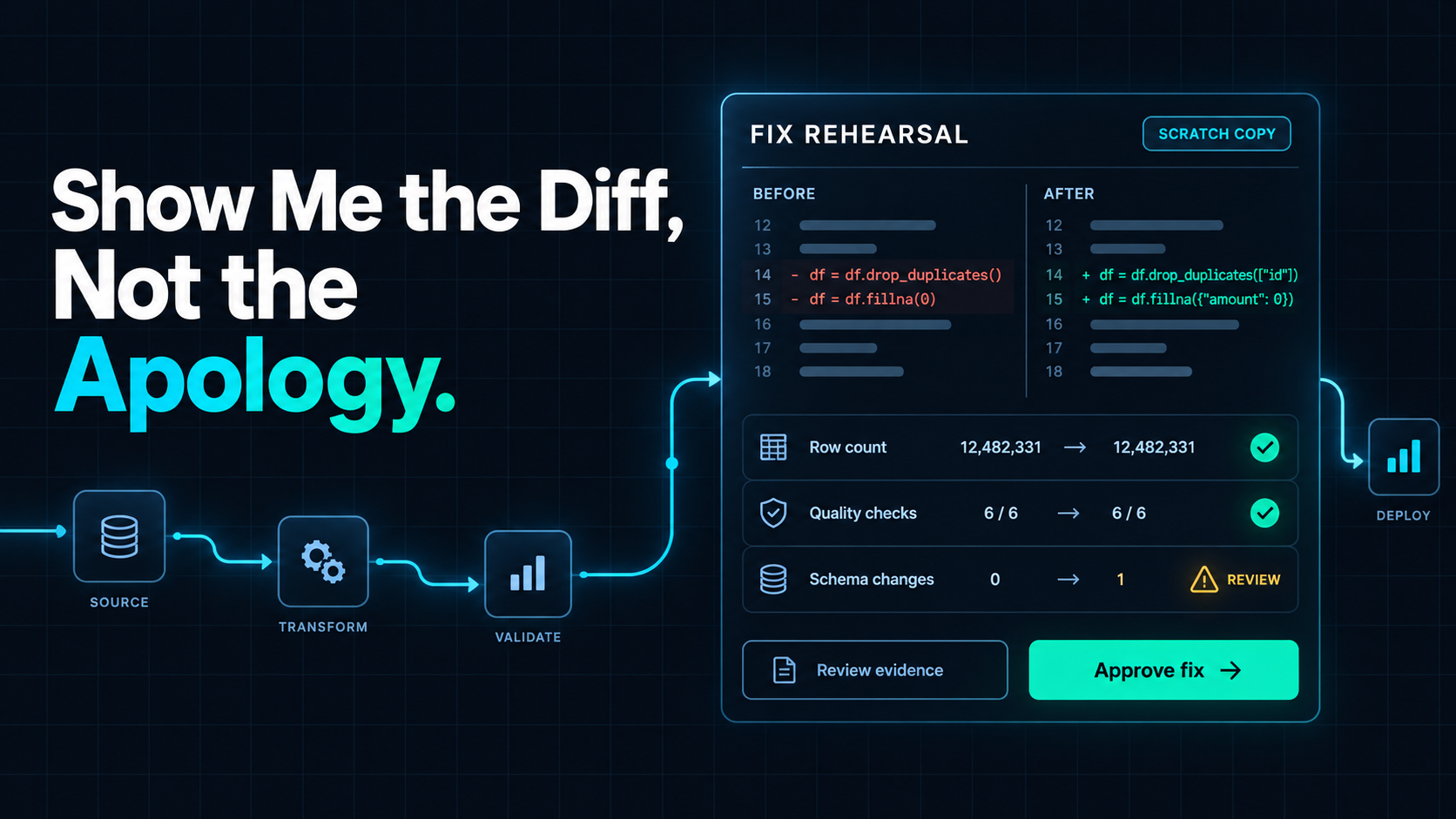
Here is the message I got from my own recovery agent, back when I first wired it up. A scheduled tap failed overnight. The agent diagnosed it, rewrote the script, and asked: “Apply fix to vendor_prices? Approve / Reject.”
I approved it. Of course I did. It was 7 a.m., the tap was red, and the alternative was reading a 300-line Python script. The run went green. It also dropped two columns the source had renamed, and a downstream report quietly lost its margin calculation for three days.
That was my fault. I clicked the button. But the button asked me a question I had no way to answer, because I couldn’t see what the fix did.
A permission prompt is not an approval
Most agent products treat human-in-the-loop as a checkbox. The agent wants to do something, a dialog appears, a person clicks, and everyone feels safe even though nobody reviewed anything.
I’ve sat in enough change-control meetings at banks to know what a real approval looks like. A ticket that says “modified the pricing job” gets sent back. The ones that get signed say what the job did before, what it will do after, what breaks if it’s wrong, and how it was tested. The approver reads that and almost never opens the code.
So that’s the bar I set for the agent. If it wants to change a script, it brings the same ticket a human engineer would.
Try the fix on a copy first
To get that evidence, the agent tries its fix on a copy of the data feed (the tap) before touching the real one. It pulls from the live source, writes to a scratch table, and compares what it got to the last run that worked.
When the result is badly broken, say half the rows are missing or a required column is gone, the fix gets thrown out. Nothing real was touched.
A change in columns is different. That might be correct, since sources do rename things, so a person has to decide. It’s exactly the case that bit me.
And if the result matches the last good run, the fix goes in on its own.
You decide how close counts as a match. On production the defaults are strict, and the agent proposes fixes instead of applying them.
What the approval card actually shows
When a fix waits for a person, the card has the numbers: row count and data-quality pass rate before and after, which columns were added or removed, the biggest null-rate swings, each threshold with pass or fail beside it, and what this resource feeds downstream. There’s a link that opens the old script and the new one side by side.
It never shows a data value, not even a single cell. Everything on it is shape and count, so the card can go to a Slack webhook or an email to someone who isn’t cleared to see the rows.
I got that idea from a customer. Their ops people can approve a change but aren’t allowed to see the data it touches. Most agent tooling assumes those are the same person.
Know which problems aren’t yours
The other half of trusting a recovery agent is knowing what it won’t touch.
If a source rejects its credentials, rewriting the script won’t help. The agent marks it as a credential problem, names the secret to check, and stops without retrying or spending a model call.
Some failures the platform’s own doctor already understands, like a full disk or a stopped service. Those get the doctor’s fix.
When a run succeeds but comes back with different columns, the incident just names the drift and what’s downstream. It stays diagnosis only unless you’ve explicitly allowed schema-drift fixes.
Most of the “agent went rogue” stories I hear are an agent retrying harder at something that was never its job. Sorting the failure before reaching for the model is most of the safety.
Incidents close themselves
An incident doesn’t sit open waiting for someone to remember it. The next time the tap runs healthy, whether you fixed the cause or the scheduled run just worked, the incident closes and withdraws anything it had queued.
If the agent notices something about a source while fixing it, say that an API paginates with an undocumented cursor, it writes that down as a suggested note for the tap generator. Someone has to accept the note before the generator ever uses it.
What I’d rather be asked
The models are good enough to write the fix now. Where self-healing falls down is the moment a person has to decide whether to let it in, and most systems give that person nothing to decide with.
So give me the diff, the counts, the thresholds, and the rehearsal. Then I’ll click the button, and I’ll know what I clicked.
Todd Fearn is the founder of Datris.ai, an open-source, agent-native data platform built on the Model Context Protocol, and he runs IData Corporation, a data engineering consultancy for financial services firms. He has spent about thirty years building production data infrastructure inside institutions like Goldman Sachs, Bridgewater Associates, Deutsche Bank, and Freddie Mac.